case study
Content Planning System
Architect + Developer—2026–present
US Mobile's video output doubled after I replaced manual topic research with a custom AI pipeline fed by analytics no third-party tool could touch.
Challenge#
Content planning at US Mobile was a manually-driven process. Upcoming launches surfaced in internal meetings, trends surfaced in weekly team sharing sessions, and the detailed research — figuring out where we could actually win — happened by hand in Ahrefs. Nothing was broken, but the two questions that gate everything downstream — what do we make and is this worth making — were bottlenecks. Research capacity, not production capacity, set the ceiling on output.
Approach#
I've used the tools — Notion, Jasper, Claude, ChatGPT, Frame.io, most of what's out there. None of them could hold the thing that actually mattered: our private signal. The data flowing from Google Analytics and YouTube — which topics were gaining velocity, which retention curves were breaking — was something only we had, and no third-party tool could ever see it. So I built custom.
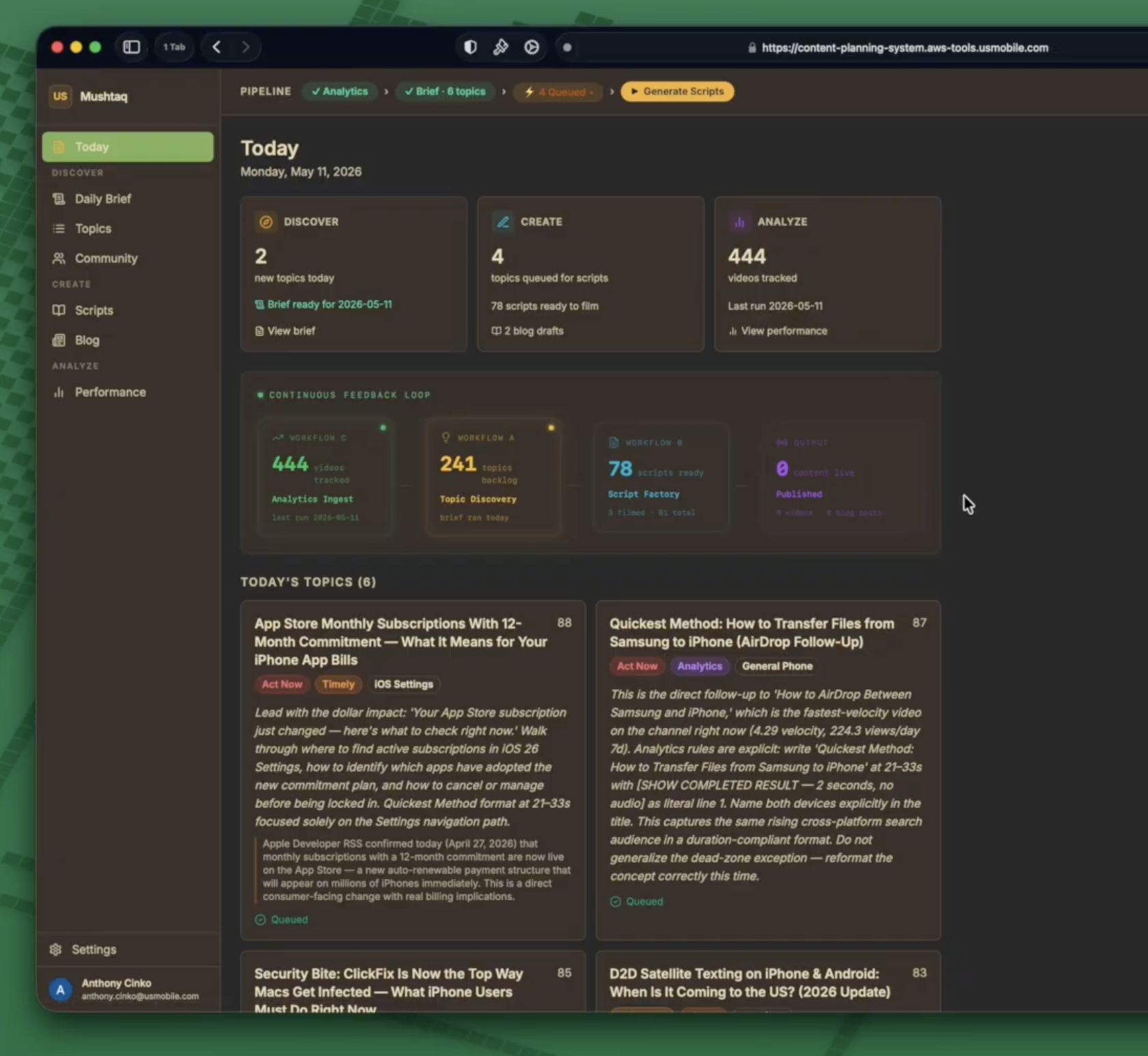
The system is a Next.js dashboard that runs the daily content automation end-to-end — topic discovery, script generation, analytics review, shorts comparison, and blog drafting — without any external scheduler. Four scheduled jobs, one container, everything in-process via node-cron.
The core loop: each night at 3 AM the analytics engine pulls 30-day and 7-day data for every tracked video, tiers them (Platinum → Bronze) by velocity and retention, then asks Claude to synthesize what the writer should do differently tomorrow. That output overwrites the live prompt the script factory reads the next morning. The system updates its own instructions from real audience signal, on a schedule, without anyone touching it.
Building custom also meant choosing my own token allowance, my own models, and loops tailored exactly to how our team decides — the proprietary data goes straight into topic research and scriptwriting instead of being flattened into a generic tool.
Stack: Next.js · TypeScript · AWS Bedrock (Claude) · Google Workspace (Sheets, Docs, Drive) · YouTube Data API + Analytics · Ahrefs · EKS / ECR · GitHub Actions
Results#
Output doubled — from 10 videos per month to 20 — because the research bottleneck disappeared.
To check whether the system itself was working, I compared equal, back-to-back ~77-day windows on both channels: before launch vs. after. YouTube views grew 18.5% (916K → 1.09M), TikTok grew 15% (152K → 175K) — a combined reach of 1.26M, up 192K views period-over-period. And the gains came from exactly where the system aims: search and discovery. TikTok's search-driven share of views jumped from 48% to 76%, YouTube Shorts-feed views nearly doubled (+93%), and off-platform views rose 46%. Directional signal rather than a controlled test — but consistent across two independent platforms in identical windows.
The growth has kept compounding since: the channel just posted its strongest 28-day period ever — over 550K views, up 48% over the prior month, with watch time up 50%. Every script driving that growth was written inside the content planning system.
The pipeline was built for US Mobile, but nothing about it is carrier-specific: any team with an audience and an analytics feed could run the same loop.